Rock Crusher Models Capacity And Upgrade Performance Features
Selecting the correct rock crusher dictates an aggregate plant’s production capacity and product quality. This engineering guide details the machine models, hourly capacities, and upgraded performance features of six mainstream crushing machines. Featuring advanced equipment from Liming Heavy Industry, the article explains how primary Jaw Crushers handle coarse reduction, while Secondary Impact and Cone Crushers offer distinct advantages in aggregate shaping and wear-part longevity. Understanding these mechanical capabilities helps plant managers drastically lower daily operating expenses and increase overall material throughput.
A rock crusher is the foundational machine of the aggregate and mining industry, specifically engineered to process natural stone and minerals into commercial-grade construction materials. The working capacity of a crusher is strictly dictated by its physical size and mechanical specifications. Different models consume different volumes of raw feed, resulting in vastly different hourly production rates and economic returns.
The mainstream market primarily relies on six major categories of comminution equipment: Jaw Crushers, Impact Crushers, Cone Crushers, Heavy Hammer Crushers, Fine Crushers, and Roller Crushers. Production capacities across these machines cover an immense range, from 5 tons per hour for small operations up to massive 3,000 tons per hour for industrial mega-plants. Each machine serves a highly specific function within the processing circuit. The Jaw Crusher is almost universally deployed for primary coarse crushing, while the remaining models handle secondary and tertiary fine crushing tasks.
To meet the surging demand for high-quality aggregates, manufacturers have continuously launched upgraded versions of these classic machines. By heavily optimizing structural designs and utilizing advanced wear-resistant metallurgy, modern crushers deliver significantly higher throughput, superior discharge particle shapes, and longer lifespans for consumable wear parts. This directly lowers daily operating expenses and maintenance downtime. Below, we break down the capacity data and performance features of these core crushing machines to assist plant managers in making the correct engineering selection.
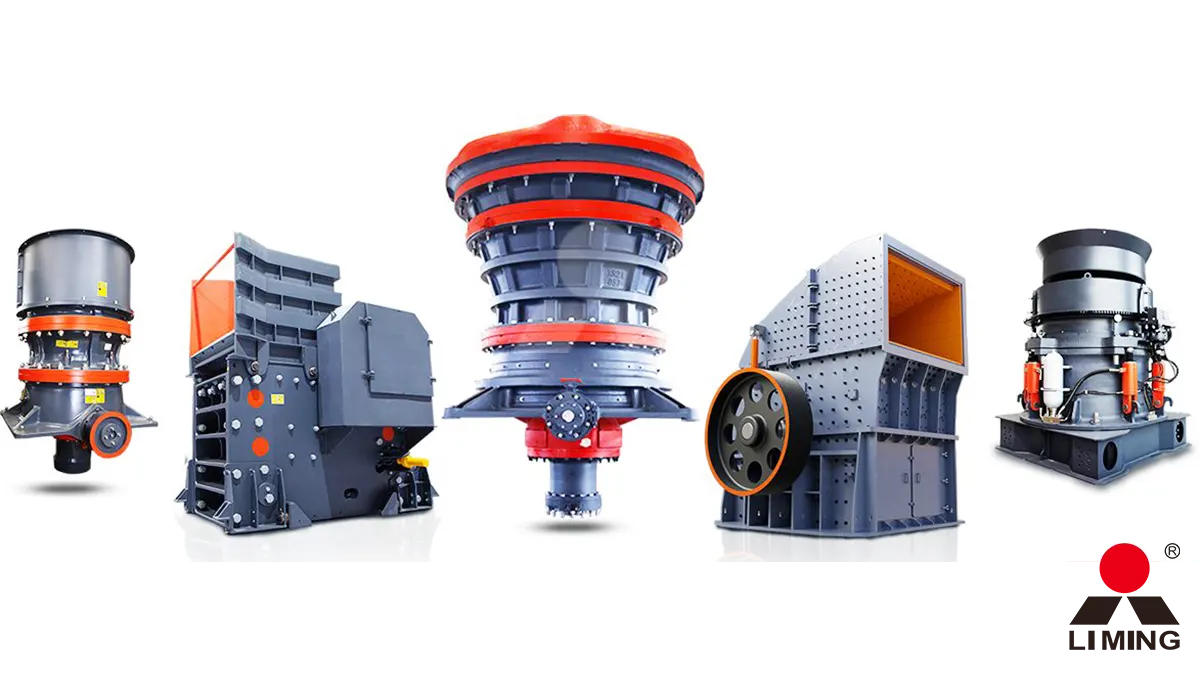
1. Jaw Crusher (Primary Coarse Reduction)
Production Capacity: 1 to 1200 Tons Per Hour
The jaw crusher is indispensable for large, medium, and small-scale production lines. Almost all primary coarse crushing is completed by this robust machine. Its mechanical structure is straightforward, yet it offers incredible reliability, a very low failure rate, and highly convenient maintenance.
Modern engineering has pushed the jaw crusher to new limits with upgraded models such as the PEW Series European Jaw Crusher and the extreme heavy-duty C6X Series Jaw Crusher from Liming Heavy Industry. The overall mechanical performance has taken a massive leap forward. From utilizing non-welded bolted frame structures to casting jaw plates from premium high-manganese steel, the production capacity, feeding efficiency, component lifespan, and overall running costs have all been vastly improved.
2. Horizontal Shaft Impact Crusher (Secondary Soft Rock Shaping)
Production Capacity: 30 to 900 Tons Per Hour
The impact crusher utilizes high-velocity kinetic strikes to shatter rock. The resulting discharge material is highly uniform and perfectly cubic, making the final aggregate highly sought after by commercial concrete batching plants.
Upgraded equipment like the CI5X Series Impact Crusher features significant structural enhancements. The CI5X incorporates a highly precise hydraulic adjustment system and a heavy-duty rotor. Certain models are designed with an optional third impact rack structure, which further enhances the particle shaping capability. Furthermore, the machine body is equipped with multiple mechanical safety locking devices, which drastically increases operational safety and reduces the manual labor intensity required during internal inspections.
3. Hydraulic Cone Crusher (Secondary Hard Rock Reduction)
Production Capacity: 12 to 2100 Tons Per Hour
Because of its immense capacity, the cone crusher is heavily utilized in large-scale building material production and massive hard-rock mining sites. While its discharge particle shape cannot quite match the perfect cubicity of an impact crusher, the operational lifespan of its internal wear components (mantles and bowl liners) is significantly longer, especially when processing highly abrasive rock like granite and basalt.
The cone crusher family features multiple advanced branch models, including the HST Single-Cylinder Hydraulic Cone Crusher and the HPT Multi-Cylinder Hydraulic Cone Crusher. The HST single-cylinder model is a marvel of modern engineering; although it utilizes only one hydraulic cylinder, that single cylinder serves three distinct functions: locking the main shaft, clearing the crushing cavity during a stall, and adjusting the discharge opening size. This drastically lowers the failure rate, matures the operational performance, and makes daily control incredibly simple.
4. Heavy Hammer Crusher (Single-Stage Reduction)
Production Capacity: 100 to 3000 Tons Per Hour
The heavy hammer crusher is designed for “one-time shaping.” It accepts large raw boulders and shatters them directly into finished gravel sizes in a single pass. When paired with a multi-deck vibrating screen, this single machine can produce multiple different commercial aggregate specifications.
Compared to traditional multi-stage crushing circuits (which require both a jaw and a secondary crusher), the heavy hammer crusher significantly reduces initial equipment configuration costs, simplifies the operational workflow, and highly improves processing efficiency. It is an extremely economical and practical crushing solution for processing soft, brittle materials like standard limestone.
5. Fine Crusher (Specialized Secondary Grinding)
Production Capacity: 10 to 310 Tons Per Hour
This equipment is frequently seen on small-scale crushing sites. It features a built-in grate structure that simultaneously acts as a screening mechanism. It is applicable for both soft and hard materials, though the final output capacity varies based strictly on rock hardness.
The fine crusher is uniquely capable of processing materials that possess a certain degree of viscosity or stickiness. The internal hammers are cast from a variety of durable alloys and are fixed directly to the spinning rotor. This design provides a larger striking surface area, ensures highly uniform material output, and guarantees a long replacement cycle for the internal components.
6. Roller Crusher (High-Hardness Fine Squeezing)
Production Capacity: 5 to 110 Tons Per Hour
The roller crusher is a compact, squeeze-type crushing machine capable of processing extremely high-hardness metallic ores and abrasive materials. It utilizes a wedge or shim adjustment method to rapidly alter the gap between the two massive steel rollers, allowing operators to easily adjust the discharge opening. This ensures the machine can seamlessly process various specifications of sand and gravel according to strict, on-demand requirements.
Conclusion: Making the Right Engineering Decision
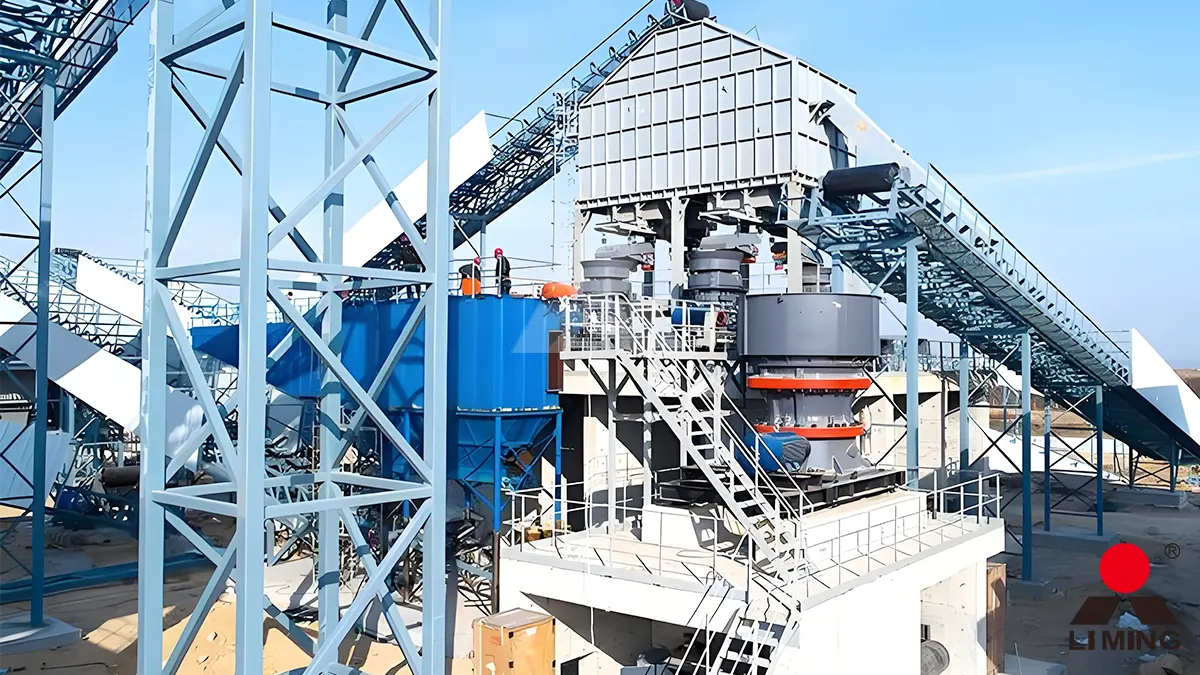
The differences in applicable scenarios, discharge particle quality, and operational difficulty between these crushing machines are stark. Selecting the right equipment must be a comprehensive decision based strictly on the hardness of your raw material, your required hourly capacity, and your finished product specifications.
At Liming Heavy Industry, we approach crushing technology from a systems engineering perspective. Whether your site requires the brutal compressive force of a C6X Jaw Crusher for primary reduction or the precision shaping of a CI5X Impact Crusher, our engineering team provides customized, turnkey solutions. Contact us today to analyze your material properties and integrate the most efficient, cost-effective crushing machinery into your production line.
