I reviewed a failed drive train last month; the V-belts were completely shredded, and the motor sheave exhibited deep burn marks. The smell of scorched rubber was pervasive. Attempting to force the eccentric shaft to rotate while the cavity is packed with 200 MPa granite creates a locked-rotor scenario, instantly transferring fatal stress to the transmission.
Mobile Crusher Maintenance and Operation Guide
A mobile crushing circuit condenses an entire aggregate processing plant onto a single, high-vibration chassis. During an operational audit at a remote iron ore expansion in Western Australia this May 2026, a multi-million-dollar mobile cone crusher was found paralyzed. The failure was not a manufacturing defect; it was a total breakdown in operational discipline. The plant had been deployed on an uneven grade, disrupting the internal oil flow and causing the main bearing to overheat. Executing a strict Mobile Crusher Maintenance and Operation Guide is the only method to secure plant uptime. Managing a mobile unit requires an architectural understanding of how chassis stability, electrical sequencing, and hydraulic purity interconnect. Operating outside these physical boundaries will instantly shift your financial ledger from profitable production to exorbitant expenditure per shift.
Chassis Stabilization and Topographical Leveling
Operating a high-inertia rotor on a tilted axis guarantees catastrophic bearing failure.
The foremost critical step in deploying wheeled units (like the NK series) or tracked units (Vertex series) is isolating the chassis from kinetic vibration and gravity drift. Once the plant is positioned, the heavy-duty hydraulic support legs must be deployed to physically lift the axles off the pneumatic tires. The tires must carry absolutely zero crushing weight during operation.
Using digital inclinometers, the chassis must be leveled to absolute zero. Operating off-axis by even 3 degrees disrupts the internal fluid dynamics of the thin-oil lubrication station. Gravity pulls the circulating oil away from the upper thrust bearing. The resulting oil starvation will cause the 250 kW eccentric shaft to suffer thermal seizure within hours, destroying the hardware amortization cycle before the first shift concludes.
The Physics of Startup and Shutdown Protocols
The operational logic applied to starting and stopping the machine is just as critical as its physical lubrication. Executing a “loaded startup” is a fatal operational error. If a power outage or operator negligence causes the mobile crusher to stop while the chamber is buried under tons of rock, restarting the machine requires a strict clearing protocol.
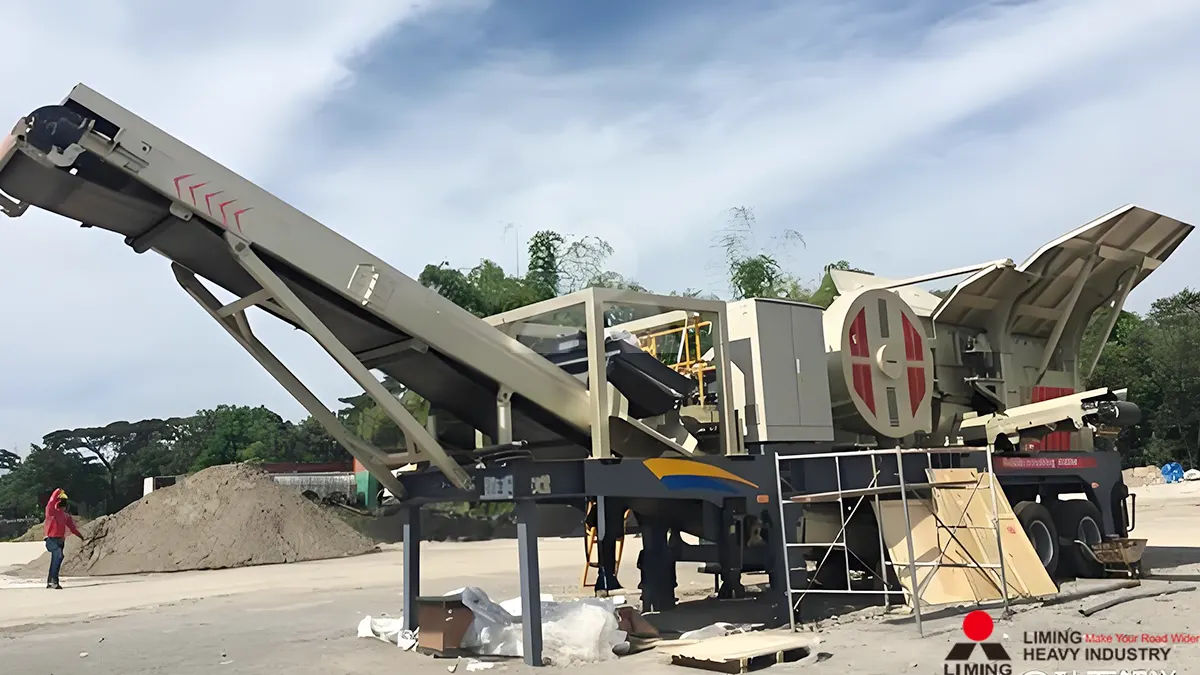
Attempting to jump-start the eccentric shaft under a static load subjects the V-belts and primary motor to a 400% electrical amp spike. This immense torque frequently shears the V-belts or fractures the drive shaft. The correct protocol mandates manually clearing the crushing cavity or utilizing the automated hydraulic clearing function before re-engaging the main drive. During normal shutdown, the upstream feed conveyor must be halted first, allowing the machine to run empty for 60 seconds to clear the chamber.
Synchronized Maintenance Matrix for Mobile Units
A preventative maintenance schedule is the only reliable method to eliminate non-planned downtime.
| Inspection Interval | Component Focus | Diagnostic Action | Risk of Failure |
|---|---|---|---|
| Daily (Pre-Shift) | Hydraulic Support Legs | Verify absolute 0° chassis level | Main bearing oil starvation |
| Daily (Operational) | Thin-Oil Station | Check filter pressure and oil temperature (< 50°C) | Thermal bearing seizure |
| Weekly | V-Belts & Drive Train | Measure tension variance (must be < 2%) | Kinetic slippage and RPM drop |
| Monthly | Crawler Tracks / Axles | Inspect track pad tension and hydraulic tram motors | Loss of site mobility |
The thin-oil lubrication system acts as the lifeblood of the mobile cone crusher. A daily audit of the oil filter differential pressure ensures that microscopic silica dust has not breached the labyrinth seals.
Mobile Circuit Operation: Kinematic & Electrical…
- Chassis Leveling Tolerance: < 1 degree deviation permitted before startup
- Startup Amp Spike Limit: Requires empty-chamber verification to prevent motor stall
- Thin-Oil Thermal Baseline: Oil temperature must verify >25°C before feeding rock
- Hydraulic System Pressure: Must maintain constant bar rating for CSS locking
- Track Tramming Speed: Restricted to low-gear when navigating 20° gradients
Hydraulic Purity and Tramp Iron Clearance
Mobile crushers rely on highly integrated, high-pressure hydraulic accumulators to lock the Closed Side Setting (CSS) and provide tramp iron clearance. When an uncrushable object (like an excavator tooth) enters the chamber, the hydraulic system must instantly release its fluid, dropping the mantle to flush the obstruction in under 60 seconds.
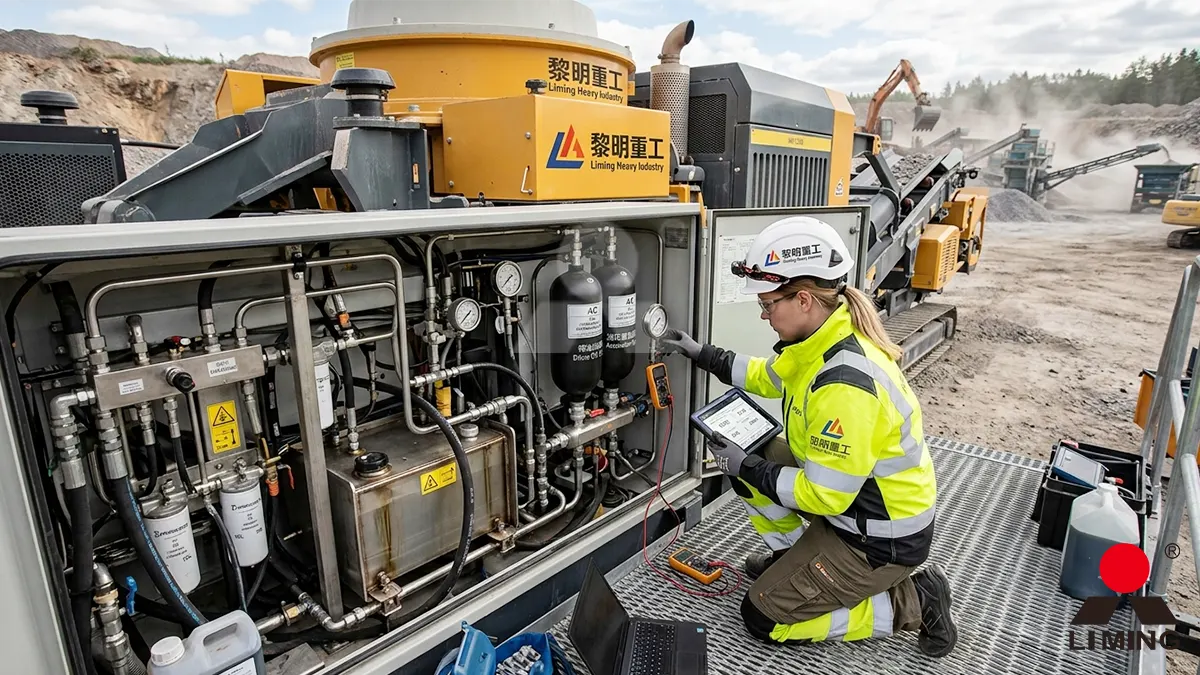
This automated defense mechanism fails if operational maintenance is ignored. Silica dust ingress into the hydraulic reservoir acts as a grinding paste, destroying the cylinder seals and clogging the proportional valves. Operators must strictly adhere to hydraulic fluid replacement schedules and utilize OEM-specified micron filters to secure the plant’s production-to-cost ratio.
Kinematic Operation Diagnostics & Maintenance Post-Mortem
Inexperienced operators treat crawler-tracked crushers like bulldozers. Tramming a 40-ton plant over jagged, uncleared blast faces tears the track pads and overheats the independent hydraulic tramming motors. Mobile crushers require a relatively cleared path to transition between blast zones safely.
Attempting to adjust screen mesh tension or eccentric weighting while the machine is processing 300 tph is impossible. The baseline amplitude and stroke angle must be locked in during the dry-run phase to ensure the screen effectively classifies the aggregate without transmitting harmonic resonance back into the mobile frame.
For tracked units equipped with dual-power (diesel/electric) capabilities, maintenance teams must audit both the onboard diesel engine and the electrical switchgear. Operating strictly on grid power extends the diesel engine’s service intervals, radically improving the capital payback velocity by minimizing internal combustion wear.
Enforce Operational Discipline to Secure Capital…
A mobile crushing plant is a precision asset operating in a highly destructive environment. Understanding the mechanics within this Mobile Crusher Maintenance and Operation Guide requires enforcing strict, data-driven diagnostic protocols. If you allow your operators to bypass chassis leveling, execute loaded startups, or neglect hydraulic fluid purity, your expenditure per shift will hemorrhage through preventable mechanical failures. Implement rigorous daily audits, manage your thermal baselines, and secure your capital payback velocity by ensuring your mobile circuit operates within its engineered physical boundaries.
