Specification Data Of Jaw Crusher
If you are looking at the specification data of jaw crusher units just to check the paint color or the shipping weight, you are already behind the maintenance curve. In my two decades of field-testing heavy-duty primary circuits from the Gobi to the Andes, I’ve learned that the numbers on a spec sheet are the only thing standing between a 20-year asset life and a pile of scrap metal by the end of the second quarter. When we talk about “specifications,” we are talking about the physics of controlled destruction.
Mechanical Tolerances and Feed Volume Dynamics
A jaw crusher is essentially a giant mechanical lever; if the pivot point (eccentric shaft) isn’t matched to the resistance of the ore, the machine will tear itself apart.
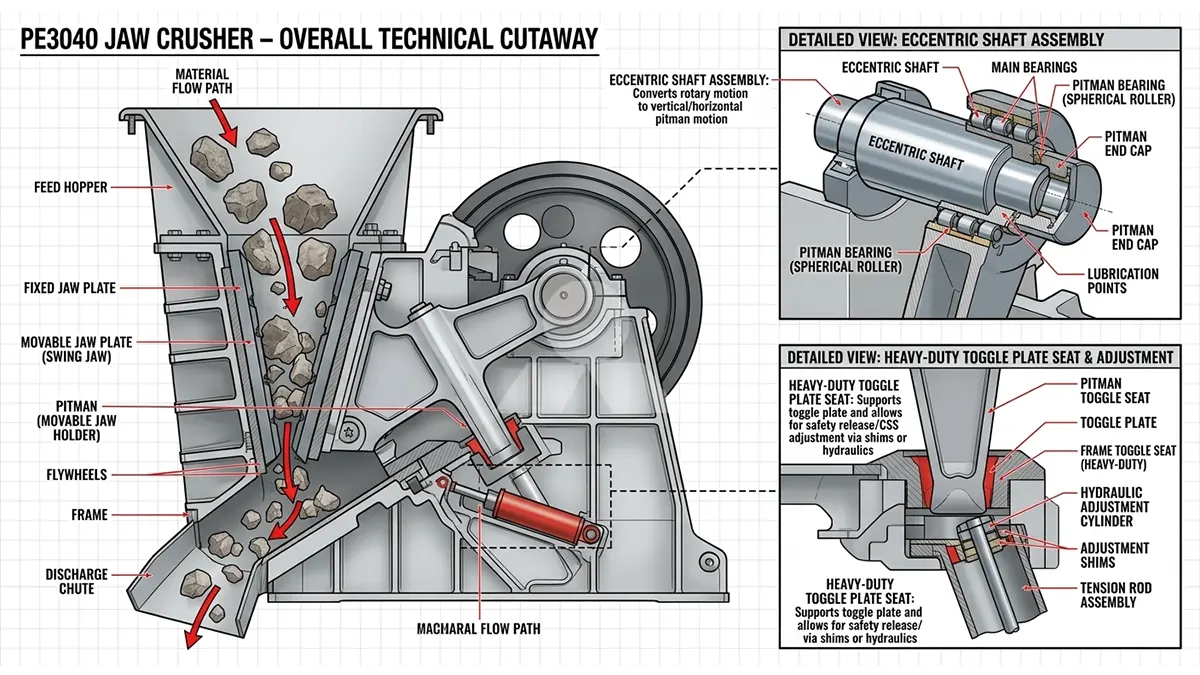
The most misunderstood metric in the specification data of jaw crusher models is the relationship between the Closed Side Setting and the eccentric throw. When you are feeding 600mm+ basalt into a PE3040 chamber, the reactive force doesn’t just vanish; it travels through the pitman and into the main bearings. If your power draw is surging beyond 140kW, you aren’t just “working hard”—you are fatiguing the steel.
You need to monitor the “choke point” where material bridges the jaw plates. On the NK75J units, we specifically look for a feed rhythm that keeps the cavity 80% full. Why? Because the kinetic energy of the moving jaw is most efficient when it has a consistent resistance to bite into. Empty strokes are just as damaging to the tension rods as oversized slabs are to the swing jaw.
Critical Metrics for Primary Crushing Circuits
Relying on estimates for your primary stage will cause a bottleneck that starves your entire secondary and tertiary circuit.
The following table outlines the verified physical parameters for our NK-series primary mobile units. These figures are the only facts that matter when calculating your hourly production costs and fuel consumption ratios on a 150-350 ton per hour site.
| Unit Model | Main Machine | Max Feed (mm) | Capacity (t/h) | Power (kW) | Weight (T) |
|---|---|---|---|---|---|
| NK75J | PE3040 Jaw Crusher | 680 | 150-350 | 141.4 | 39 |
| NK100E | PE3040 Jaw Crusher | 680 | 150-350 | 138.5 | 35 |
Thermal Expansion and Lubrication Constraints
If you ignore the operating temperature of your bearings, the specification data of jaw crusher units won’t save you from a catastrophic seizure.
During summer operations in high-ambient-heat zones, the 141.4kW motor on an NK75J generates massive internal heat within the bearing housings. We’ve seen operators try to push the capacity past 350 tons per hour without checking grease viscosity. When the oil film breaks down, the friction between the eccentric shaft and the bronze bushings creates a thermal expansion that can literally fuse the metal parts together.
Maintenance leads must enforce a strict lubrication schedule every 8 hours of continuous operation. You aren’t just adding grease; you are flushing out microscopic metal shards and silica dust that penetrate the seals. A clean seal is the only thing protecting that 39-ton investment from becoming a very expensive garden ornament.
Field Audit: Identifying Structural Fatigue Points
- How does the “Max Feed” of 680mm actually affect the jaw plate lifespan?
- Feeding a consistent 680mm slab causes the most stress at the top of the chamber. If the rock is too hard (Mohs 7+), the jaw cannot “grip” the material, leading to bouncing and excessive wear on the manganese liners. We recommend scalping the fines before they hit the jaw to prevent “cushioning” which reduces crushing efficiency.
- Why is there a weight difference between the NK75J (39T) and the NK100E (35T) using the same crusher?
- The NK75J includes a larger chassis and additional integrated feeder components (FK0936). That extra 4 tons of steel is dedicated to vibration dampening and structural rigidity, allowing for higher stability in high-vibration applications.
- What happens if the power draw exceeds 141.4kW during a shift?
- This indicates either uncrushable material (tramp iron) is in the chamber or the CSS is set too tight for the feed hardness. Immediate inspection of the toggle plate is required to ensure it hasn’t buckled—which is its job to protect the main shaft.
- Can the PE3040 handle wet, sticky clay-heavy feed at 350 t/h?
- No. The specification data of jaw crusher units assumes dry, friable material. Sticky feed will “pancake” in the bottom of the chamber, causing a pressure spike that can stall the 141.4kW motor and snap the tension rods.
Final Assessment: Verifying Data Against Reality
The numbers in the specification data of jaw crusher plants are targets, not guarantees. If you don’t match your feed size to the 680mm limit or maintain the 141kW power curve, the physics of your quarry will eventually win. Audit your circuit every morning, watch the pressure gauges, and never assume that a piece of paper can replace a grease gun and a keen ear for mechanical distress.
Validate Your Primary Stage Physics
“A spec sheet tells you what it can do; a site audit tells you what it is actually doing.” — Senior Site Lead
